
Green status, no artifact
On 22 August, the workflow reported success while the ledger recorded 14 permission denials and no artifact. Run: ap-20260822-actions. A success status alone was insufficient evidence of delivery.
Field report · a small iPhone app
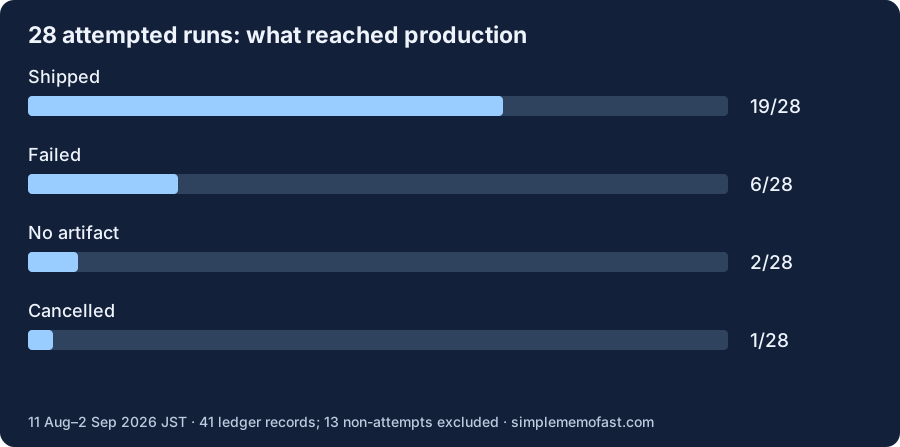
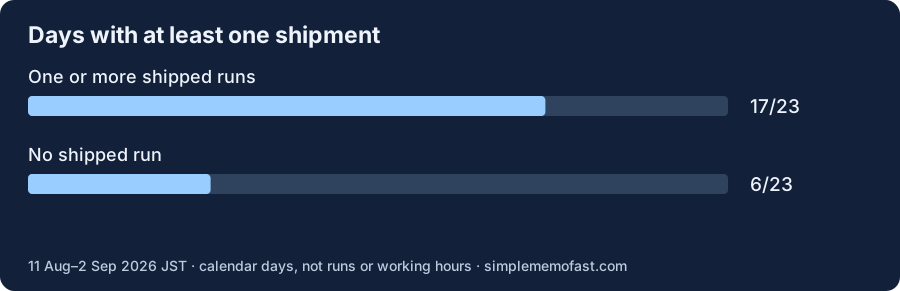
We published the runs that shipped, the runs that failed, and the times a human stepped in. Across 23 days, 19 of 28 attempted runs shipped work. A successful workflow status did not always mean useful work was produced.
Published 5 September 2026 · Observation window: 11 August–2 September 2026, Japan time · By the Simple Memo development team
This is a historical case study of Simple Memo - for Obsidian, a working iPhone app. The operating loop measures results, chooses a task, makes a change, checks it, ships eligible changes, and records the outcome. It is a study of app operations, not a claim that an AI independently owns or runs a company.
We selected public ledger records dated 2026-08-11 through 2026-09-02, inclusive. A row is one recorded run. The 13 rows with attempted=false include 11 gate skips and 2 no-run records. They remain in the download but are excluded from the shipment and intervention denominators.
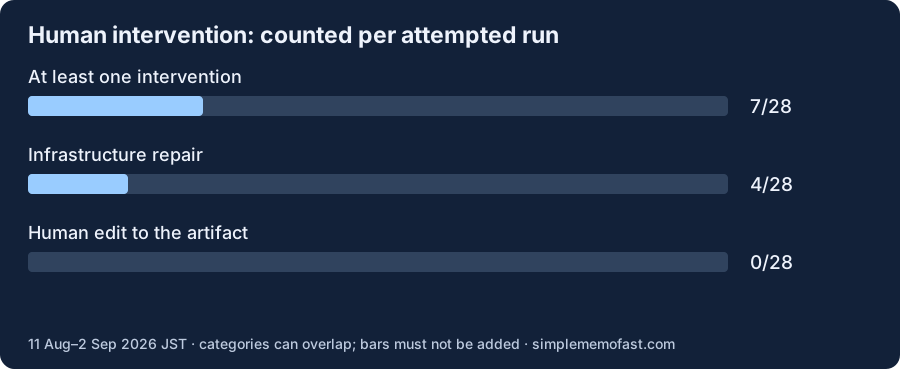
A shipment means outcome=shipped in the ledger. It can be a website article, an update, or an operations change; it is not an App Store release. A human intervention means at least one recorded intervention on an attempted run. It includes infrastructure repair, initial setup, substitution, and an owner request. It does not measure minutes worked.
The snapshot was extracted from a specific revision of the public ledger. Later records do not change this observation window. The live ledger and full Japanese operations page continue to change. The page and all three charts are generated from the same downloadable snapshot.
| Attempted-run outcome | Runs | Share of attempted runs |
|---|---|---|
| Shipped | 19 | 67.9% |
| Failed | 6 | 21.4% |
| No artifact | 2 | 7.1% |
| Cancelled | 1 | 3.6% |
There were no recorded human edits to the shipped artifacts. This does not mean there was no human involvement: infrastructure repairs occurred in four attempted runs, and initial setup, substitution, and an owner request each appeared in one run.
On 22 August, the workflow reported success while the ledger recorded 14 permission denials and no artifact. Run: ap-20260822-actions. A success status alone was insufficient evidence of delivery.
On 29 August, a fallback claimed the day’s branch but produced neither an article nor a PR. The primary route treated the claim as work in progress and skipped. Run: ap-20260829-ccr0920.
On 30–31 August, the primary route hit an account usage limit. The 31 August fallback shared the account and also failed. Different schedules did not provide independence from the same limit.
These are observations from the source records, including later diagnostic annotations. They are not a controlled comparison of AI vendors, and the original cause was not always known at the time of failure.
The published operating policy separates reversible website work from pricing, contracts, spending, and App Store release decisions. Humans remain responsible for those decisions and for device verification. The complete, changing permission table is on the Japanese operations page.
Task-inventory automation rates, shipment rates, and human working-time savings have different denominators. This report does not infer one from another. It also does not demonstrate automatic production rollback, end-to-end incident recovery, or an increase in revenue.
This is one team, one app, a short observation window, and an operator-maintained ledger. Some entries were reconstructed from workflow history. Missing interventions would undercount human involvement. There is no control group and no measured counterfactual human workload.
For coverage, retain the observation dates and the denominator. A suitable description is: “In Simple Memo’s 11 August–2 September 2026 operations ledger, 19 of 28 attempted runs shipped work; 7 of those 28 recorded human intervention.” Link to this report or its snapshot so readers can check the definitions.
To inspect the product behind these records, see the Obsidian workflow, Siri setup, or the product facts and media kit. For corrections or reproducibility questions, contact the developer.